

If you are carrying high-interest credit card debt in October 2026, your home equity is probably the cheapest money you can borrow, and the question is not whether to use it, it is which tool to use. The average credit card APR is 19.67% as of October 14, 2026, per Bankrate’s weekly national survey, while the average 30-year fixed mortgage rate is 7.40% per Freddie Mac’s survey for the week ending October 15, 2026, the average HELOC rate is 7.34%, and the average home equity loan rate is 8.63%. This guide compares the three ways families turn home equity into debt relief, shows you the one question that usually decides which one you want, and walks through a before-and-after case study so you can see the math in plain numbers.
I am Adam Heaney, a mortgage loan officer with 28 years in the business. I help families across California, Arizona, Colorado, Florida, Tennessee, Texas, and Washington make smart decisions with the equity they have built. You do not need to be a finance person to get this right; you need someone to explain the trade-offs clearly and calmly, and that is exactly how I work, often with a personalized video walkthrough you and your family can watch on your own time.
The October 2026 Numbers That Make This Conversation Worth Having
Here is the fundamental fact of this market: borrowing on a credit card costs roughly two and a half times what borrowing against your home costs, and the balances involved are at record highs on both sides.
- Credit cards: the average APR is 19.67% as of October 14, 2026, per Bankrate. Americans owed $1.263 trillion on credit cards at the end of the second quarter of 2026, up $54 billion from a year earlier, per the Federal Reserve Bank of New York’s Household Debt and Credit report. WalletHub’s 2026 study puts the average household balance at about $11,313, and the Federal Reserve reports that 45% of adult credit cardholders carried a balance for at least one month in the past year.
- HELOCs: the national average rate is about 7.34% as of October 14, 2026, per Bankrate, with offers ranging from roughly 3.99% to 11.99% depending on the lender, credit profile, and terms.
- Home equity loans: the average fixed-rate home equity loan is about 8.63% as of the same date, per Bankrate.
- Cash-out refinances: the average 30-year fixed rate is 7.40% for the week ending October 15, 2026, per Freddie Mac’s Primary Mortgage Market Survey, up from 7.28% on October 1 and from 6.27% a year earlier.
Homeowners have the equity to work with. According to ICE’s August 2026 Mortgage Monitor, tappable equity, the amount homeowners can borrow while keeping at least a 20% cushion, reached a record $11.7 trillion in the second quarter of 2026, within a record $18 trillion of total mortgage-holder equity, spread across about 47.5 million borrowers who each hold roughly $212,000 on average. And families are increasingly choosing the route that protects their existing mortgage rate: ICE reported that 54% of all equity extraction in the first quarter of 2026 came through second liens like HELOCs, with about 248,000 borrowers pulling roughly $25 billion, the strongest first-quarter volume for second liens in 18 years. A September 2026 survey by Newrez found 51% of homeowners carry a credit card balance month to month, and 42% of those homeowners said they have considered using their home equity to pay it off faster. This is not a fringe strategy; it is how millions of households are responding to the most expensive credit card market in history.
The Three Tools, in Plain Language
A cash-out refinance replaces your entire first mortgage with a bigger one and gives you the difference in cash. You owe $386,000 on a home worth $560,000? You refinance into a new $430,000 first mortgage, pay off the old loan, and pocket roughly $44,000 minus closing costs. You get one loan, one payment, and usually the lowest rate of the three tools, but you are refinancing your whole balance, not just the cash you take out.
A HELOC (home equity line of credit) is a second mortgage that works like a credit card with your house as collateral. Your existing first mortgage stays completely untouched, and you draw what you need up to your approved limit, paying interest only on what you actually use. During the draw period, payments are often interest-only, which makes the monthly math very attractive. The trade-off: most HELOC rates are variable, so the rate can move with the market, and lenders can freeze or reduce your line in some circumstances.
A home equity loan (sometimes called a second mortgage or a term loan) is also a second mortgage, but it gives you one lump sum at a fixed rate with a fixed payment over a set term, typically 5 to 20 years. You get the certainty of a cash-out refinance without having to touch your first mortgage. The rate is usually a little higher than a HELOC, about 8.63% on average today per Bankrate, and you pay interest on the full amount from day one, whether you needed all of it or not.
The One Question That Decides Which Tool You Use
Families ask me which tool is “best,” and the honest answer is that it depends on one number above all others: the interest rate on your current first mortgage.
If your current mortgage rate is well below today’s 7.40% market (say you locked in a 3% or 4% rate in 2020 or 2021), a cash-out refinance is usually the wrong move, because it resets that low rate on every dollar you owe, not just the money you take out. That rate reset on $386,000 can cost far more than the interest you save on $50,000 of credit card debt. For these families, a HELOC or home equity loan is the smarter play: your first mortgage and its payment stay exactly where they are, and only the new debt carries today’s rate. This is precisely why second liens now account for 54% of equity extraction: families are choosing to protect a sub-market first mortgage.
If your current mortgage rate is close to today’s market (say you originated in 2025 at 6% to 6.5%), a cash-out refinance becomes much more attractive. The rate reset hurts far less, you lock in one fixed payment for the life of the loan, and you usually get the lowest cost of funds. Many families in this position find the simplicity of a single payment worth a lot on its own.
If you want the certainty of a fixed payment but refuse to touch your first mortgage (for example, military families who want to protect a VA loan, or anyone who prefers a set end date), a home equity loan is your middle path: a fixed second mortgage with a fixed payment, no refinance of the first lien.
Before and After: A Case Study With Real October 2026 Numbers
Math is easier to trust when you can see it, so let me introduce you to a hypothetical family. I am using current October 2026 market averages, and I want to be completely straight with you: this is a teaching example, not a promise about your situation. Your home value, your balance, your rate, and your debts will all be different, which is exactly why we run your real numbers together before deciding anything.
Meet the Riveras, a hypothetical family with a debt problem and an equity solution. Their home is worth about $560,000, and they owe $386,000 on a 30-year fixed mortgage they took out in 2025 at 6.1%. Their principal and interest payment is about $2,339 a month. Along the way they accumulated $50,000 in consumer debt:
- Credit cards: $32,000 at an average APR of 19.67%, with minimum payments of roughly $560 a month combined and about $524 a month of interest
- Auto loan: $11,000 remaining at 8.5%, about $330 a month
- Personal loan: $7,000 remaining at 11.9%, about $235 a month
- Total: $50,000 of debt with roughly $1,125 a month in payments
Add it all up and the Riveras are sending out about $3,464 a month before a single utility bill. Against a gross household income of $10,000 a month, their obligations eat about 35% of their income before taxes, which is uncomfortable and, if they ever tried to add a car loan or a second property, it would shrink the room lenders give them in a hurry.
Path A: a cash-out refinance. Their home’s 80% ceiling is $448,000, so a new loan of $446,000 (the $386,000 balance, the $50,000 of debt, and most of the closing costs) fits. At today’s average 30-year fixed rate of 7.40%, the new principal and interest payment is about $3,088 a month. Compare that with the $3,464 they pay today: about $376 a month freed up, roughly $4,500 a year, and the debt is gone. Their obligations drop from about 35% of income to about 31%.
Path B: a HELOC. The Riveras keep the 6.1% first mortgage untouched, an important point since refinancing would reset that rate on $386,000 to today’s 7.40%. They open a $50,000 line at today’s average HELOC rate of 7.34% and pay off the debt. During the draw period, the payment is often interest-only, about $306 a month. Their total obligations drop from $3,464 to about $2,645 a month, roughly $819 a month freed up in the near term, and their debt-to-income ratio improves from about 35% to about 26%.
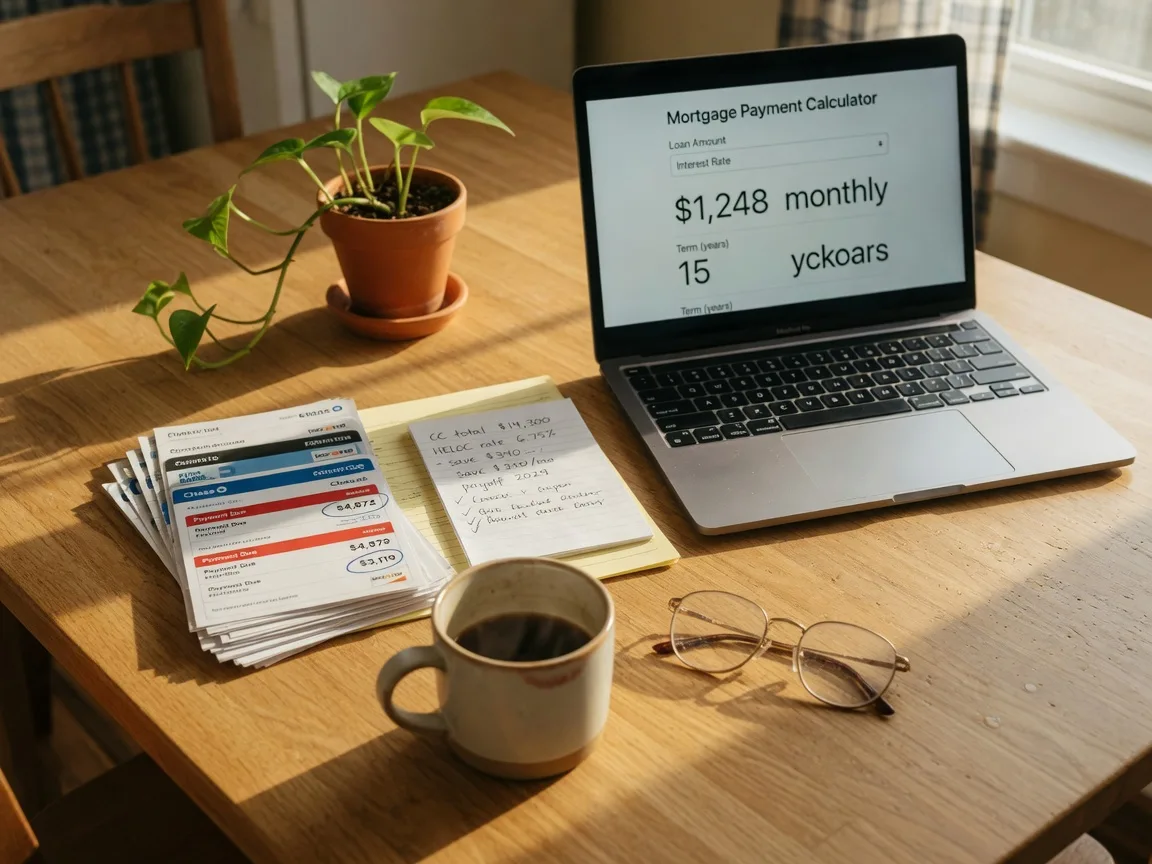
The point of showing both paths is that each one wins in a different situation. The Riveras’ 6.1% rate is below today’s market, so the HELOC protects a mortgage that is cheaper than anything they could get today, and it frees more monthly cash in the near term. If their first mortgage had been originated at 6.9% instead, the cash-out refinance would look better, because the rate reset costs so much less and they would get a single locked-in payment. The deciding variable is always the rate on the mortgage you already have, and that is the first thing I check with any client.
How Consolidation Changes Your Debt-to-Income Ratio
Your debt-to-income ratio, DTI for short, is the share of your gross monthly income that goes to your monthly debt obligations, and mortgage lenders live and die by it. Conventional loan guidelines generally want your total debt-to-income ratio around 43% to 50% or below, and every point of DTI you can give yourself back is room you may need later, for a car, a future home purchase, or simply for breathing room.
Here is what consolidation actually does to that ratio. Credit card minimums are set so that interest-heavy balances crawl down slowly, so $32,000 at 19.67% can sit at roughly $560 a month in minimums for years. Move that balance into a 7.34% HELOC and the interest component collapses from about $524 a month to about $196 a month, even before you factor in the payment structure. The Riveras went from about 35% of income to about 26% with the HELOC path and about 31% with the cash-out path. Same family, same debt, same month, and the difference between 35% and 26% is sometimes the difference between qualifying for a loan and not qualifying.
There is a lesser-known angle here that I like to flag: consolidating also converts revolving credit (where high utilization drags down your credit scores) into installment credit, and one of the fastest ways to recover credit score points is to take a maxed-out card down to near zero. The effect is not guaranteed and it varies by borrower, but it is a real, observable pattern that consolidation improves the picture in more than one way.
The Costs Nobody Mentions in the Commercial
I want you to go into this with your eyes fully open, so here are the costs and changes that do not make it into the marketing materials.
- A cash-out refinance carries full refinance closing costs. This is a brand new first mortgage, and closing costs typically run 2% to 5% of the loan amount. On a $446,000 loan that is roughly $9,000 to $22,000, paid at closing or rolled into the balance. The math only works if you keep the loan long enough to spread those costs out.
- The rate reset is real. As the Riveras’ example shows, refinancing resets the rate on your entire balance, not just the cash you take out. If your first mortgage is well below today’s 7.40%, that reset can quietly cost more than the debt interest you save, and it is the single most commonly overlooked number in this whole decision.
- HELOC rates are mostly variable. The 7.34% average is not locked. If rates rise, your payment rises with them, and the interest-only draw payment is a floor, not a forecast: when the draw period ends, the payment jumps up as the line converts to amortizing repayment. Plan for the repayment payment, not the draw payment.
- A home equity loan charges interest on the full lump sum. Unlike a line of credit, you pay on everything from day one, so borrowing $50,000 to use $35,000 is paying for money you are not using.
- Closing costs and fees exist on second liens too. HELOCs and home equity loans typically carry appraisal, origination, and annual fees, often 2% to 5% of the line, and some lines carry early termination fees if you close them within the first few years.
- The interest is usually not tax-deductible for debt consolidation. Under the tax rules in effect since 2018, interest on home equity debt is deductible only when the funds are used to buy, build, or substantially improve your home. Money used to pay off credit cards does not qualify with the IRS in most cases, so do not build your decision around a deduction you will not get.
What I Need You to See Before You Sign
I have done this long enough to watch consolidation go beautifully right and painfully wrong, and the difference is almost never the numbers. It is the behavior around them.
The biggest risk is that unsecured debt becomes secured debt. Credit card debt is unsecured: if you stop paying, the lender damages your credit and pursues collections, but they cannot take your house. A HELOC, home equity loan, or cash-out refinance ties that debt to your home, and if you cannot make the payments, the consequence is far more serious: you can lose the home. The Consumer Financial Protection Bureau warns about exactly this. Consolidation only makes sense when the payment is genuinely affordable and stays affordable.
The second biggest risk is running the cards back up. Paying off $32,000 in cards and then charging them up again leaves you with the cards, the home equity debt, and a worse position than you started in. The Newrez survey found 51% of homeowners carry a card balance month to month, so the habit is common, and it is the number one way consolidation fails. The strategy is only as good as the budget that replaces it.
And one more caution, specific to HELOCs: lenders can freeze or reduce a line in certain circumstances, such as a significant drop in your home’s value or a sharp change in your credit. The line you are approved for is not a guarantee you can draw on it forever, so keep a cushion and do not treat the full limit as available cash.
Questions Families Ask Me
Which is cheaper, a HELOC or a cash-out refinance? It depends on your first mortgage rate, which is the honest answer every time. If your rate is far below market, a HELOC is cheaper because it leaves that rate alone. If your rate is near market, a cash-out refinance often wins because you get a lower cost of funds and one fixed payment. HELOCs also carry lower upfront costs, but a variable rate, so “cheaper” is a question of both today and the next ten years.
How much equity do I need? For a conventional cash-out refinance on a primary residence, the new loan generally cannot exceed 80% of the home’s value, so you keep at least 20% equity in the home. HELOCs typically allow a combined loan-to-value of roughly 80% to 90%, depending on the lender. FHA cash-out refinances also cap around 80%, while VA cash-out refinances can go higher for eligible veterans.
Does consolidating hurt my credit? The new credit inquiry and new account can cost a few points at first, but paying down revolving balances is one of the strongest positive moves for credit scores, and most families see utilization-driven recovery within a few months. Every borrower is different, so treat this as a pattern, not a promise.
Is the interest tax-deductible? Generally no, when the money is used to pay off consumer debt. Under current IRS rules, home equity interest is deductible only for funds used to buy, build, or substantially improve your home. Talk to your tax professional about your specific situation before assuming a deduction.
What if I have a 3% mortgage from a few years ago? Then protect it. A cash-out refinance would reset that rate on your entire balance, which is usually the most expensive mistake in this whole playbook. A HELOC or home equity loan is almost always the better answer for families sitting on a sub-market first mortgage, and it is why second liens now make up 54% of all equity extraction.
The Bottom Line
The October 2026 math is unusually clear: credit cards cost 19.67% on average, home equity costs roughly 7.34% to 8.63%, and American families hold a record $11.7 trillion of tappable equity alongside $1.263 trillion of credit card debt. Bridging that gap with the right tool, a cash-out refinance, a HELOC, or a home equity loan, can free hundreds of dollars a month, improve your debt-to-income ratio, and give you a real plan to be debt-free, provided the spending pattern behind the cards is addressed and the costs are inside the decision from the start.
But the averages do not decide your situation; your numbers do. That is why I do this the way I do: you bring me your mortgage statement, your credit card statements, and your goals, and I run the math on every path, cash-out versus HELOC versus home equity loan, with your actual rate, your actual equity, and your actual timeline. Then I record a personalized video walkthrough your whole family can watch together, because a decision this important deserves to be understood, not just signed.
Important Disclosure
This article is for educational purposes only and does not constitute financial, legal, tax, or mortgage lending advice. Figures referenced are published market data as of October 2026: a 7.40% average 30-year fixed mortgage rate from the Freddie Mac Primary Mortgage Market Survey for the week ending October 15, 2026; a 19.67% average credit card APR, a 7.34% average HELOC rate, and an 8.63% average home equity loan rate from Bankrate’s weekly national surveys as of October 14, 2026; $1.263 trillion in U.S. credit card debt from the Federal Reserve Bank of New York’s Q2 2026 Household Debt and Credit report; an average household credit card balance near $11,313 from WalletHub’s 2026 credit card debt study; the 45% of adult cardholders carrying a balance from the Federal Reserve’s report on the economic well-being of U.S. households in 2025; record tappable home equity of $11.7 trillion within $18 trillion of total mortgage-holder equity across about 47.5 million borrowers, plus Q1 2026 equity withdrawal activity, from ICE’s 2026 Mortgage Monitor reports; and the Newrez survey findings on homeowners carrying credit card balances and considering home equity. These figures are subject to change and vary by borrower, lender, and location. The Rivera family scenario is a hypothetical teaching example; the payments, interest, DTI percentages, and savings shown are illustrative, principal-and-interest only, and will vary based on actual loan amounts, rates, terms, credit profiles, underwriting, and market conditions. Conventional cash-out refinances generally cap at 80% loan-to-value on a primary residence, HELOC combined loan-to-value limits typically range from about 80% to 90%, and qualification depends on credit, income, assets, and appraisal. Consolidating unsecured debt converts it into debt secured by your home, with risk of foreclosure if you are unable to make payments. HELOC rates are commonly variable, and lenders can freeze or reduce lines under some circumstances. Consult a qualified financial, legal, or tax professional regarding your individual circumstances.
Author: Adam Heaney, Loan Officer, NMLS #283076, Emery Financial
Not sure which debt consolidation strategy fits your family?
Let’s run your real numbers together. Bring me your mortgage statement, your credit card statements, and your goals, and I will compare a cash-out refinance, a HELOC, and a home equity loan on your actual situation, then record a personalized video walkthrough your whole family can review on your own time. No jargon, no pressure, just the honest math.