

The October 2026 market just turned in favor of move-up families: the average 30-year mortgage rate eased to 7.32% for the week ending October 22, 2026, down from the 7.40% peak it touched two weeks earlier, a record 22% of sellers are cutting their asking prices, and 44.7% of recent home sales included a seller concession, the highest August share in at least five years. At the same time, the families doing the moving up are sitting on record equity, about $310,000 per mortgaged homeowner on average. This guide shows you how to sell your current home and buy your next one in this market: how to price your home so it actually sells, how to bridge the money gap between your two closings, how to negotiate the purchase side, and the real math behind it all.
I am Adam Heaney, a mortgage loan officer with 28 years in the business, helping families across California, Arizona, Colorado, Florida, Tennessee, Texas, and Washington move up to the home they have outgrown. Nearly four out of five homebuyers today are repeat buyers, and most of them tell me the same thing: this is the most confident they have ever felt about selling, and the most nervous they have ever felt about buying, all at once. The market has shifted, and my job is to explain exactly what that shift means for your numbers, usually with a personalized video walkthrough your whole family can watch on your own time.
The October 2026 Market Just Turned in Your Favor: Four Numbers to Know
Here is the short version of what changed. For most of the last five years, sellers held nearly all the cards. The four numbers below say that has flipped, and that is good news for families who are trying to trade up.
- Rates eased off their peak. The average 30-year fixed rate was 7.32% for the week ending October 22, 2026, per the Freddie Mac Primary Mortgage Market Survey, down from 7.40% for the weeks ending October 8 and October 15. Rates are still roughly 1.1 points higher than the 6.19% of a year ago, so affordability remains the background noise of this market, but the arrow is no longer pointing straight up.
- Inventory is back. The National Association of Realtors reported 4.8 months of supply in September 2026, with 1.60 million unsold homes on the market, the highest level since November 2019. Buyers have options again, and options are leverage.
- Sellers are cutting prices at a record rate. Redfin found 22% of U.S. homes for sale dropped their asking price in the four weeks ending October 11, 2026, a record for this time of year, and median asking prices fell 0.3% year over year, the first decline since March. The pricing power that used to belong to sellers has moved across the table.
- Seller concessions are now routine. Sellers gave concessions in 44.7% of U.S. home sales in August 2026, per Redfin, the highest August share since at least 2020, and about 15.8% of sales included both a price cut and a concession. Asking the seller to help with your rate or your closing costs is no longer a bold request; it is how a big share of this market is actually transacting.
One honest caveat before we go further: you are a seller too. The price cuts and concessions that make the purchase side kinder also mean your current home needs to be priced like the market it is. That is exactly why this guide covers both halves of the transaction, because a move-up only works when the sale side and the purchase side fit together.
Your Equity Is the Engine: What Record Home Equity Means for Your Move
The second powerful force in this market is on your side of the ledger. Total mortgage-holder equity reached a record of roughly $18 trillion in the second quarter of 2026, according to ICE’s Mortgage Monitor, with about $11.7 trillion of it considered tappable across roughly 47.5 million borrowers. Cotality (the data firm formerly known as CoreLogic) put the average equity per mortgaged homeowner at about $310,000, and ICE calculated the average tappable amount at about $212,000 per borrower. Those are national averages, so your number is whatever your zip code, your purchase price, and your payoff say it is, but they tell you the scale of the asset most move-up families are carrying into their next purchase.
Your equity does two jobs in a move-up, and families who understand both jobs make better decisions. First, it becomes your down payment, which is why the typical repeat buyer puts down about 23%, the highest share since 2003, per the National Association of Realtors. Second, and less obviously, it keeps the new loan small enough that your new payment stays livable. That second job matters more this year than in any year I can remember, because of what I call the replacement payment problem.
Here is the hard math. A family with $400,000 still owed on a 3.5% mortgage is paying about $1,800 a month in principal and interest. If they refinance that same $400,000 at today’s 7.32%, the payment jumps to about $2,750 a month, roughly 50% higher for the exact same borrowed amount. When you are moving up you are not just refinancing, you are borrowing more, so the combined effect is real. The equity you bring into the transaction is the single best answer to that problem: the more you can put down, the smaller the loan, and the smaller the loan, the less the 7% rate hurts. That is why I always want to know your current balance and your home’s true value before we talk about anything else.
Step One: Price Your Current Home Like the Market It Is
When 22% of sellers are cutting their asking prices and list prices are declining for the first time since March, the most expensive mistake a move-up family can make is overpricing the home they are selling. Here is why: in a market with 4.8 months of supply, buyers have alternatives, and the showings a home gets in its first weeks on the market are the ones that matter most. An overpriced home burns through that window, then needs a price cut anyway, often a larger one than a realistic list price would have demanded, and the calendar keeps running while it sits. For a move-up family, a slow sale does not just cost money; it stresses the purchase you are trying to make on the other side.
Pricing your home right from day one, ideally a touch under the most recent comparable sales rather than over them, does three things. It generates the strongest showing traffic in that first window. It gives you the best shot at an offer close to your number quickly, which protects your timeline. And when the next buyer’s appraiser runs their comps, an honestly priced sale closes the way it was written, with no last-minute surprises. In this market, a clean execution beats an optimistic list price every single time, and a buyer who can close on schedule is the strongest kind of buyer there is.
Step Two: Choose How You Bridge the Gap Between Selling and Buying
Every move-up comes down to one structural problem: you have two transactions and, usually, one set of money. There are four standard ways to bridge the gap, and the right one depends on your market, your income, and how much you love the home on the purchase side. I have written deep guides on each of these, so here I will give you the decision framework in plain language.
- Sell first, then buy. The cleanest path. You make the strongest possible offer on your next home because there is no contingency and no double payment, and you can even negotiate a rent-back to stay put for a month or two after closing. The cost is flexibility: you are on a clock to find your next home, and you may move twice. If your timeline allows it, this is the path I recommend most often in a market like this one. I walked through the full decision in Sell First or Buy First.
- Make a contingent offer. Your offer says the purchase happens if your current home sells, typically with a kick-out clause that lets the seller keep showing and accepting backup offers. In 2026 it has real power, because with 4.8 months of inventory, sellers are more willing to wait than they were in the frenzy years. It is still a weaker offer than a non-contingent one, so price and terms matter. My guide to contingent offers has the full playbook.
- Use a bridge loan. A bridge loan is short-term money that lets you close on the new home before the old one sells, typically interest-only, repaid when your current home closes. It is genuinely useful, and it is also genuinely expensive: bridge rates in the current market run roughly 9% to 12%, sitting well above the 7.00% prime rate. The question is not whether the rate is high; it is whether losing the right home costs more than the bridge interest. Usually it does, and that is the math we run together. See bridge loans explained for the full breakdown.
- Keep your mortgage and draw a HELOC. A home equity line of credit, at about 7.36% on average in late October 2026 per Bankrate, lets you keep your low-rate first mortgage untouched and use your equity as the bridge to your next down payment. The catch is qualifying: the HELOC payment counts in your debt-to-income ratio alongside the new mortgage, so this works best for families whose income has room. It is the right tool for a specific slice of move-up families, not for everyone.
The honest truth is that most families cannot simply qualify for two full mortgage payments in a 7% market, which is why this decision belongs before you write an offer, not after. We model all four paths against your income, your balances, and your target payment, and then the right one is usually obvious.
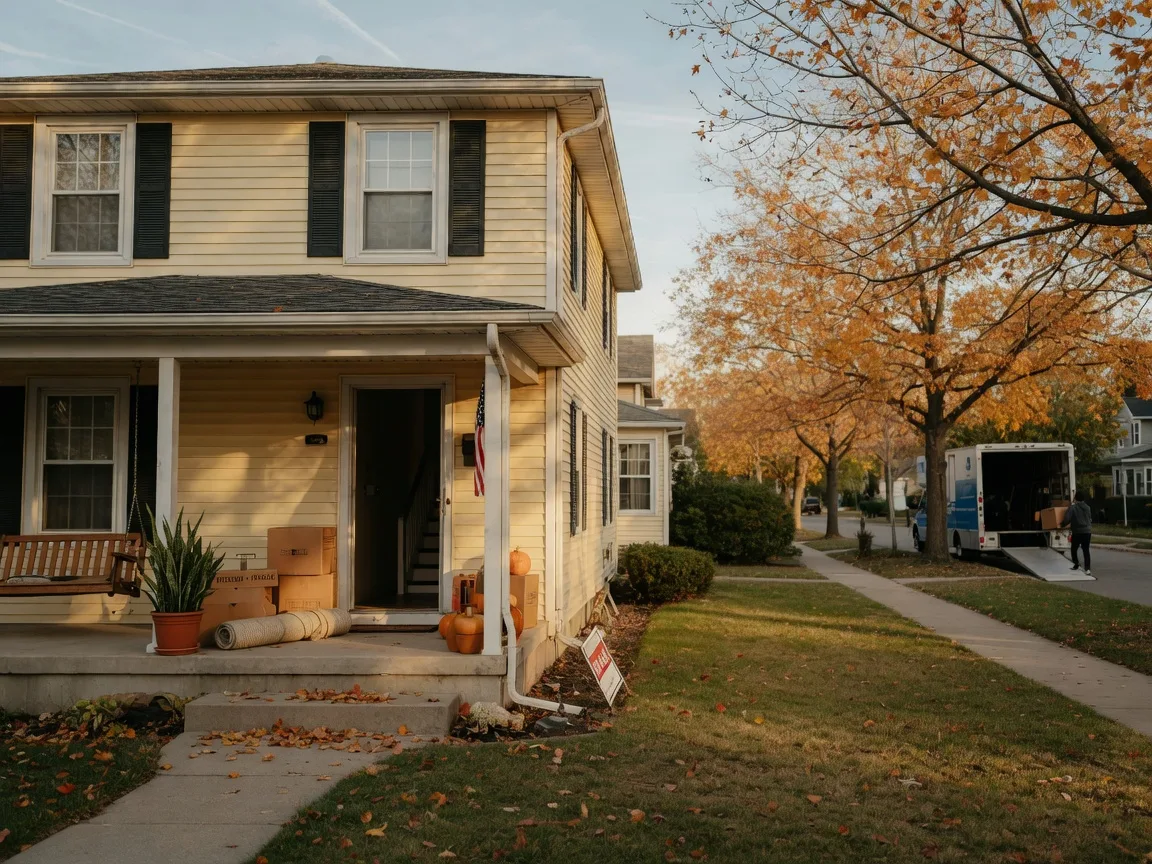
Step Three: Negotiate the Purchase Side, Because the Market Is on Your Side
Here is where the leverage you have heard about actually shows up. When 44.7% of sales include a seller concession and 15.8% include both a price cut and a concession, your offer can reasonably ask for help. The two most valuable things a move-up buyer can request are closing cost assistance and a seller-paid rate buydown, because both attack the root problem in this market: the monthly payment.
A 2-1 buydown is the workhorse. The seller contributes money at closing, and your rate is reduced by 2 percentage points in year one and 1 percentage point in year two, then settles at your full rate from year three on. On a $690,000 loan at a 7.32% note rate, the principal and interest payment is about $4,740 a month. With a 2-1 buydown it drops to roughly $3,840 in year one and $4,280 in year two, a real difference in the two most expensive years of a move, when you just bought furniture, paid movers, and doubled your property tax bill. The typical cost is about 2% of the loan amount, roughly $13,800 here, which is exactly the kind of concession sellers are agreeing to at a record rate right now. My full 2-1 buydown guide explains the mechanics in depth.
One piece of advice on price versus buydown: in a high-rate market, a dollar spent lowering your rate is usually worth more than a dollar shaved off the price, because the rate keeps working for you for thirty years and the price cut only works once. The good news is that this market is producing both at the same time, so you are not always forced to choose.
The Real Math: A Hypothetical Move-Up Family
Math is easier to trust when you can see it, so here is a teaching example. I am using current October 2026 market averages, and I will say it plainly: this is a hypothetical illustration, not a promise about your situation. Your home value, your balance, your income, and your negotiation will all be different.
Meet the Martinez family, a hypothetical couple moving up from a three-bedroom townhome. They bought in 2018 for $385,000, and their townhome is now worth about $580,000, broadly in line with the appreciation we are seeing in many of the markets I serve. They owe $245,000 on a 3.75% loan from a 2021 refinance, so they hold roughly $335,000 of equity, a little above the $310,000 national average for a long-time owner.
Instead of overreaching on price, they list at $582,000, just under the closest comparable sales, and they accept an offer at $580,000 within a few weeks. Selling costs run about 6%, roughly $34,800, so after paying off the mortgage they walk away with about $300,000 in cash.
On the purchase side they find a four-bedroom home listed at $920,000 in a market where list prices are starting to fall. They offer $920,000 with two requests: a 3% concession, about $27,600, and a 30-day rent-back on the seller’s side if needed. The seller accepts. The concession covers the $13,800 cost of a 2-1 buydown and most of the closing costs.
Here is the payment story. They put $230,000 down, 25%, close to the 23% median for repeat buyers, leaving a $690,000 loan. Their old principal and interest payment was about $1,135 a month. The new one, with the buydown, is about $3,840 in year one, $4,280 in year two, and $4,740 from year three on. That is a big jump, and I will not pretend otherwise. But they kept roughly $70,000 in cash after the down payment and closing costs, their payment in the first two years is hundreds of dollars lower than the full rate, and they got the home their family needed without gambling on a rate forecast.
The lesson of the Martinez family is not that the numbers are easy. They are not, in any 7% market. The lesson is that every piece of the move-up, realistic pricing, clean equity, a negotiated concession, a targeted buydown, stacks on the others, and the families who do all four get a materially better result than the families who only do one.
Timing the Transition: The Sequence That Works in This Market
Here is the practical sequence I walk move-up families through, in the order that protects you:
- Get pre-approved with your real equity numbers before you list. Your pre-approval should be built on what you will actually net from the sale, not a guess, because that net figure sets your honest budget for the next home.
- Value both homes at the same time. Have an honest conversation about what your current home is worth in a 4.8-month-supply market and what the target home is actually trading for, not just asking. The gap between those two numbers is your real challenge.
- List your current home priced to sell quickly. With 22% of sellers cutting prices, the first window of showings is your best shot. A clean two-to-three-week sale at a realistic price beats a six-week listing with two price cuts.
- Choose your bridge before you need it. Decide, in writing, whether you are selling first, using a contingent offer, a bridge loan, or a HELOC. Pre-approve whichever path you choose so the offer on your next home is ready the moment the right one appears.
- Make your offer with your leverage in hand. Ask for the concession, request the rent-back, attach your clean pre-approval, and let the buyer’s market work for you.
- Coordinate your closings. In a normal transaction that is roughly 30 to 45 days from offer to closing, so plan your two closings close together with a lease-back on one side if you need overlap. Moving once, with the bridge or rent-back in place, is the win.
On the rate question, which is really the timing question: no one can tell you with honesty where rates go next, and anyone who claims certainty is selling something. What we know is what is in front of us, rates easing off a peak, record equity, record concessions, and price cuts. A seller-paid buydown locks in a lower payment for your two hardest years without asking you to predict the future, which is why it is such a good fit for this exact moment.
What Move-Up Families Ask Most Right Now
Can we qualify for two mortgages at once? Rarely, and honestly. Lenders count both full payments in your debt-to-income ratio, and at 7.32% the combined payment is usually too heavy for comfortably qualifying. That single fact is why the bridge conversation happens before the offer, not after it. The families who do qualify for two payments at once are the exception, and we find out by running your real numbers, not by guessing.
How much equity do we really need to move up? There is no fixed number, because the real target is a new payment you can live with, not a dollar of equity. The national averages, about $310,000 of equity and $212,000 of tappable equity per borrower, tell you what the market looks like, but your zip code and your income decide your number. Bring me both sides of your balance sheet and we will find it.
Should we wait for rates to fall below 7%? The honest answer is that nobody knows, and that rates have already moved from 7.40% to 7.32% in a single week, which tells you how little a forecast is worth. Meanwhile, a seller-paid buydown or concession you can negotiate today lowers your payment without you betting on a prediction. Waiting has a real cost too: the market has shifted toward buyers, and that leverage is not guaranteed a permanent seat at the table.
Are bridge loans worth 9% to 12%? Only when the alternative costs more. If the right home appears and your current home needs another 30 days, paying bridge interest on the gap for a couple of months is usually far cheaper than losing the home. If you have time on your side, sell first and skip the bridge entirely. The rate is the price of optionality, and you should only buy optionality you will actually use.
Should we ask for a price reduction or a seller-paid buydown? In this market you can often get both, about 15.8% of sales did in August. If you have to prioritize, put the money toward the rate: a buydown lowers your payment for years, while a small price cut is a one-time event. We can run both scenarios side by side in a few minutes.
The Bottom Line
The October 2026 market has handed move-up families something they have not had in years: real leverage. Rates are easing off a 7.40% peak, inventory has climbed to levels not seen since 2019, a record share of sellers are cutting prices, concessions are routine, and your equity is sitting at an all-time high. The families who win in this environment price their current home like the market it is, choose their bridge before they need it, and negotiate the purchase side like the buyer’s market it has become.
That is the conversation I love to have, and it starts with your numbers, not a brochure. Tell me what your current home is worth, what you owe, and what you are hoping to move into, and I will help you run the four bridges, the pricing strategy, and the buydown math against your real situation, then record a personalized video walkthrough your whole family can watch together. No jargon, no pressure, just the honest numbers, the same way I have helped families across California, Arizona, Colorado, Florida, Tennessee, Texas, and Washington for 28 years.
Important Disclosure
This article is for educational purposes only and does not constitute financial, legal, tax, or mortgage lending advice. Figures referenced are published data as of late October 2026: a 7.32% average 30-year fixed mortgage rate from the Freddie Mac Primary Mortgage Market Survey for the week ending October 22, 2026, down from 7.40% for the weeks ending October 8 and October 15, 2026, 7.28% for the week ending October 1, 2026, and up from 6.19% a year earlier; a median existing-home price of $417,500, existing-home sales of 3.99 million at a seasonally adjusted annual rate, 4.8 months of supply, and 1.60 million unsold homes, the highest inventory level since November 2019, from the National Association of Realtors’ September 2026 existing-home sales report released October 13, 2026; 22% of homes for sale dropping their asking price in the four weeks ending October 11, 2026, a record for that time of year, a 0.3% year-over-year decline in median asking prices, the first since March 2026, seller concessions in 44.7% of August 2026 sales, and 15.8% of sales including both a price cut and a concession, from Redfin; roughly $18 trillion in total mortgage-holder equity, about $11.7 trillion of it tappable across roughly 47.5 million borrowers, and average tappable equity of about $212,000 per borrower, from ICE’s second-quarter 2026 Mortgage Monitor, and average equity per mortgaged homeowner of about $310,000 from Cotality for the second quarter of 2026; an average HELOC rate of about 7.36% and an average home equity loan rate of about 8.67% as of October 21, 2026, per Bankrate’s national weekly surveys, and a prime rate of 7.00% per the Federal Reserve’s H.15; bridge loan rates of roughly 9% to 12% in the current market as reported in general industry commentary; and repeat buyers at 79% of purchases with a median repeat-buyer down payment of 23%, per the National Association of Realtors’ 2025 Profile of Home Buyers and Sellers. The Martinez family is a hypothetical teaching example; their purchase price, appreciation, sale price, equity, down payment, concession, and payments are illustrative and will vary based on actual figures and market conditions. Mortgage payment examples shown are principal and interest only and exclude taxes, insurance, and fees; a 2-1 buydown typically costs roughly 2% of the loan amount. Loan programs, rates, and terms are subject to change and to underwriting and qualification, and this article does not create a client or advisory relationship.
Author: Adam Heaney, Loan Officer, NMLS #283076, Emery Financial
Ready to run your move-up numbers?
Your free consultation comes with a personalized video walkthrough of your situation: what your current home will really net, which bridge fits your family, and what a seller concession plus buydown does to your new payment in a 7.32% market. No jargon, no pressure, just clarity.